


Many people have heard about such a diagnosis as psoriasis, but few people know that there is also nail psoriasis - a chronic disease of the nail plates caused by lichen planus.Its nature is non-infectious, its course is wavy, i.e.psoriasis can also affect the nails and then we are talking about psoriatic onychodystrophy (nail psoriasis).
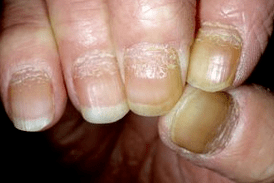
In 50% of cases, psoriasis on the nails is combined with skin lesions, but is always a harbinger of skin lesions.Its frequency, as an independent pathology, among patients with psoriasis is 7%.The overall prevalence of psoriasis in the world is 3%.At the same time, the appearance of the hands and feet deteriorates externally, wounds and spots appear, nails peel, their color changes, which causes complexes in their owners.Problems arise not only from the cosmetic side, there are malfunctions in the functioning of the cardiovascular system and central nervous system.Age category: persons under 25 years of age, most often men.
Provoking causes and factors
Many people believe that stress and nervous excitability are the sources of psoriasis, but in fact the reason is different.Stress only provokes pathology, or rather its transition from a sluggish process to an acute one.But there are only 2 true causes of psoriasis: hormonal imbalances and heredity (40% of cases).
In addition, there are provoking factors, so psoriasis is considered a polyetiological disease:
- metabolic disorders;
- cold and dry weather, which, combined with reduced immunity, worsens the skin surface;
- mechanical damage to the dermis;
- treatment with beta blockers, NSAIDs, antihypertensive drugs, drugs containing lithium;
- untreated infections;
- various stresses;
- pregnancy and postpartum conditions.
The exact cause of the disease has not been established, but it is considered autoimmune, i.e.when immunity decreases, antibodies to their own cells begin to be produced: if there are failures, the cells of the nail plates begin to divide incorrectly, and becauseIf their structure is incorrect, the body regards them as foreign, reacts to them with inflammatory reactions and produces antibodies to them.At their localization sites there are many leukocytes, which carry out these inflammatory reactions.The disease has much in common with ordinary psoriasis and is characterized by layering of cells on top of each other.Thus, so-called psoriatic plaques are formed.
The pathogenesis of nail psoriasis consists of a disorder of cell proliferation and differentiation:
- The cell cycle shortens.
- An excessively large number of cells are formed.
- Growths and thickenings appear on the nail plate.
Classification of pathology
There are several successive stages in the development of nail psoriasis:
- Stage 1 – “thimble” symptom;
- Stage 2 - onycholysis stage;
- Stage 3 - hemorrhagic;
- Stage 4 - trachyonychia.
Stage 1- “thimble” symptom - a scattering of chaotic tiny depressions and pits (0.5-2 mm) on the nail surface.The nail plate becomes cloudy and darkens.Pressure is painful.
Stage 2- painless detachment of the nail plate without inflammatory reactions.It can be localized central, distal or lateral, as well as complete or partial.A psoriatic border forms near the separated nail - at first pink, then becomes yellowish.The separation of the nail often begins from the distal edge;onichamades is also a separation of the nail, but much more rapid, there is no border (it is difficult to treat).When a nail peels off, voids are formed under it, where dust, dirt, air gets in, there is also an epidermis here, which gives a gray color to the nail plate (if the space under the nail is completely clogged with air bubbles, this symptom is called Terry’s nails, in other, incomplete cases it is called leuconychia).As the process progresses, the nail thickens and its consistency changes.
Stage 3- brown stripes of various shapes and sizes appear under the nail (a consequence of the destruction of small blood vessels), various pink and red spots, and purulent discharge from under the nails may be added to them.
Stage 4- nails thicken, they become dull (onchocercose), the surface becomes rough and uneven.Sometimes an indentation appears in the center of the nail and it becomes cochleari - coilonychia.In this case, in the early stages, flattening of the plate is observed, and subsequently it becomes concave.Subungual tissues are not subject to change.Paronychia also appears here - thickening of the skin after a severe inflammatory process around the nail.The finger becomes hyperemic.Onychogryphosis is a thickening of the nail that resembles a claw or a bird's beak.
Onychodystrophy- increased fragility of the affected nails, their splitting in different directions.The “stearin stain” symptom is characterized by increased peeling when attempting to scrape.The scales have a silvery whitish color, like after grinding stearin.
Symptomatic manifestations
Nail psoriasis clinically has 3 stages:
- The beginning of inflammation, the progressive stage - white and yellow dots (papules) actively appear on the nails, they increase in size.But the inflammation is still superficial and has not penetrated into the depths, so the treatment is successful.There is no pain; towards the end of the stage, peeling of the upper layers of the nails appears.
- Stationary - the stage seems to stabilize: no new spots appear on the nails, inflammation decreases, but pain and discomfort persist.Nails and the skin around the nails become dry, crack, and sometimes bleed.
- Regressive - at this stage, the spots disappear, false edges appear around the nails in a whitish color, and severe itching persists.Inflammatory phenomena also affect soft tissues (paronychia).In this case, the tactile sensitivity of the fingers is impaired, pain and burning appears in them, fine motor skills are impaired, and the fingers quickly get tired.
Diagnostic measures
Blood changes are typical for advanced cases; at the beginning of the disease, the diagnosis is made based on an external examination.Additional research methods include a blood test for leukocytosis and ESR, and analysis of the skin element near the roller.
Possible consequences and treatment
Nail psoriasis is not completely cured, but with long-term treatment and elimination of provoking factors, the condition of the nails can be significantly improved.Psoriasis tends to aggravate diseases of the cardiovascular system and central nervous system.In addition, a decrease in immunity causes a periodic increase in temperature, and the absorption of folic acid is impaired.
How to treat nail psoriasis?There is no standard method for treatment, because...Symptoms in all patients are always individual, without a common denominator.But treatment for this pathology is always complex.Correction of nutrition and elimination of provoking factors play a significant role - this ultimately increases the effectiveness of treatment.
- How to treat nail psoriasis?In mild cases, treatment is not required; it is enough to use medicinal varnishes - the nails are not affected.From medications in the form of local and oral agents.Hormonal agents - they have an anti-inflammatory effect, normalize the condition of the nails, and have a desensitizing effect.Moreover, after 2 weeks of use, regression of inflammation is observed in 70% of cases.Glucocorticoids of the latest generation are non-halogenated.Only a doctor should prescribe hormonal drugs; they must also be discontinued according to a plan; abrupt withdrawal of them causes an unpredictable “withdrawal” syndrome in the form of allergic edema.In addition to them, you need to take calcium supplements.
- How to treat nail psoriasis additionally?A remedy such as sulfur-salicylic ointment, salicylic ointment, has a therapeutic effect.They relieve itching and clear plaques.
- Antihistamines have a desensitizing effect.
- Preparations containing dithranolom have a pronounced effect against inflammation and stop proliferation.The attending physician uses various schemes and techniques, but all of them are used for a long time - months, or even years.
- Immunodepressors are effective at any stage of the disease.
- Multivitamins with mineral supplements - selenium, zinc and silicon.For external use, ointment with retinoids.They promote faster exfoliation, reducing the horny mass under and around the nail, normalize the rate of cell division and the thickness of the epidermis.
- The treatment of psoriasis of the nails, hands and feet also includes physiotherapy: exposure to tissue with diathermy, excimer laser, plasmapheresis, phonophoresis, dynamometry, cold therapy, hemosorption, infra- and ultrasound, and ultraviolet irradiation are also used.Particularly effective in the treatment of nails with psoriasis are magnetic laser therapy and electrosleep, ultraviolet irradiation, PUVA therapy - phototherapy is performed: irradiation of ultraviolet ray-sensitive areas of the nail plate causes a decrease in the production of immature cells of the epidermis.
- Products with monoclonal antibodies.They destroy those cells that cause the formation of plaques and restore nails.
- Biological response modifiers are capable of exerting a selective effect on cells with impaired immunity.
- Local treatment consists of ointments with hormones and non-hormonal ones.They accelerate regeneration and relieve inflammation.
- Homeopathy is successfully used for nail psoriasis: it is non-addictive and non-dependent, non-toxic, successfully affects tissue and cellular processes, taken in the form of tablets and ointments.
- Surgical treatment is carried out in case of ineffectiveness of conservative therapy.Performed on an outpatient basis with local anesthesia, the nail is removed.
- Diet: giving up alcohol and smoking;the diet contains 30% acidic, 70% alkaline foods;exclude fried, smoked, salty, fatty foods;milk, nuts, citrus fruits, strong tea and coffee, potatoes, tomatoes, eggplants, bell peppers.
- Treatment of nails at home with folk remedies - only after permission from a doctor.Sea buckthorn oil inside, rubbing it into the nails, you can rub olive oil, corn oil, tea tree oil;herbal infusions with inula, lingonberry, string, horsetail, etc. For nail psoriasis, treatment at home includes using instead of tea, decoctions of bay leaves, calendula, sage, horsetail, St. John's wort, calamus, cocklebur herb, baths with oatmeal, corn starch, oak and chamomile bark, celandine, and seaweedsalt.
Prevention and prognosis
Prevention includes maintaining your immunity, moisturizing your nails and cuticles with creams, using gloves when working with household chemicals, and avoiding injury to your nails.It is better to cut your nails short and avoid pedicures and manicures.It is necessary to normalize your sleep and rest patterns; baths with sea salt will be useful.It is necessary to promptly treat any infections and take multivitamins 2 times a year.The prognosis with continuous treatment is favorable, although it is impossible to completely cure the pathology.In case of conscription, illness gives an exemption from compulsory military service in peacetime.